
Quick answer
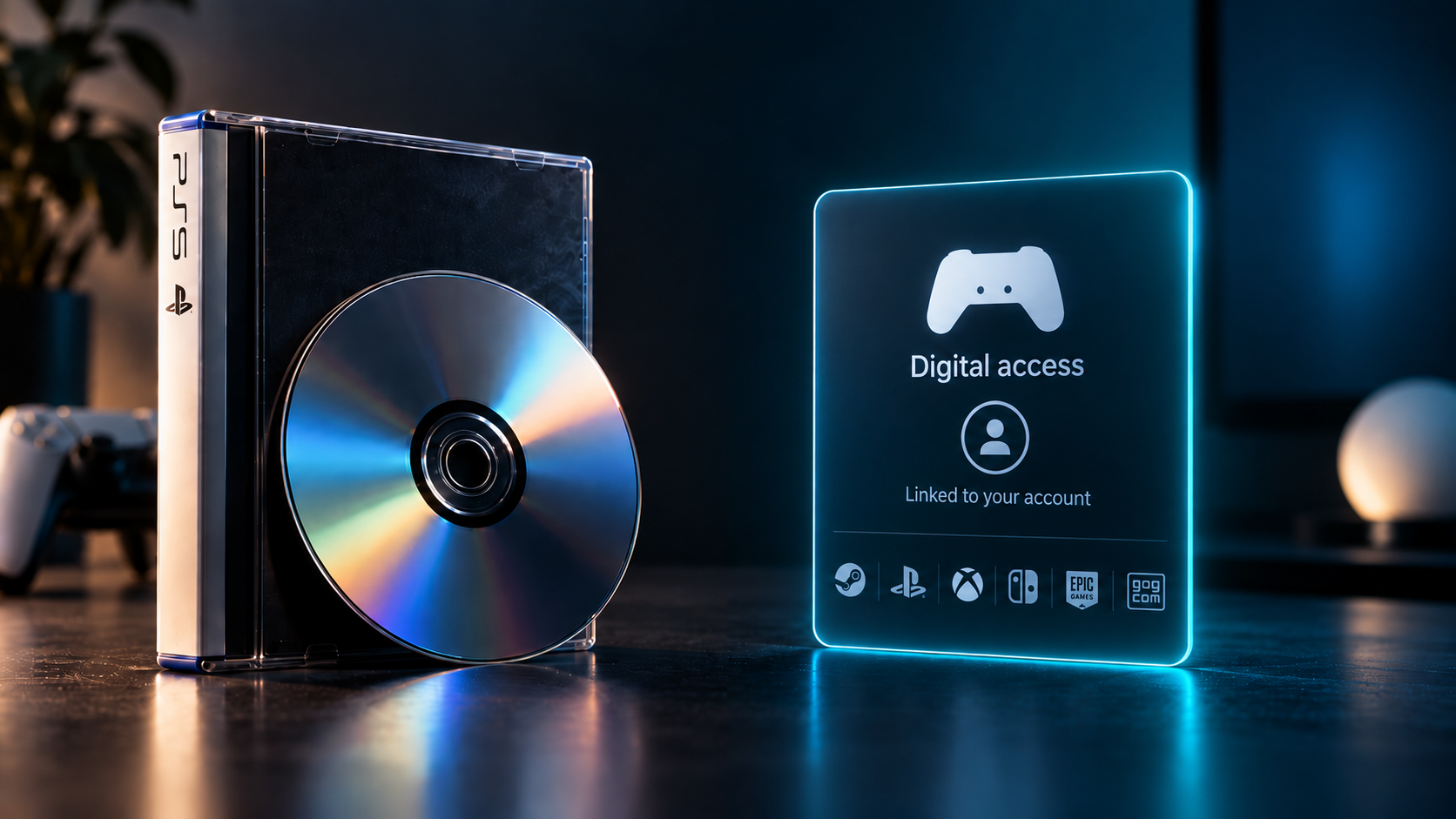
Across Steam, PlayStation, Xbox/Microsoft Store, Nintendo, Epic and GOG, current first-party terms use licence-based legal structures for digital content in some form. Steam, PlayStation, Microsoft, Nintendo and Epic explicitly use licensed-not-sold or equivalent language; GOG’s User Agreement grants a personal licence to use GOG content. What differs sharply is practical control. GOG’s DRM-free offline installers and optional client leave you with much more control over downloaded games than account- and DRM-dependent stores. Practical control, legal title, copyright ownership and resale rights are separate questions.
Contents
What “owning a digital game” can mean
A lot of arguments about digital ownership are really arguments about different meanings of the same word.
Copyright ownership is the broadest and least relevant to an ordinary purchase. Buying a game does not make you the owner of its code, art, music or other intellectual property, just as buying a book does not transfer the copyright in the novel.
Owning a physical copy is different. If you buy a disc or cartridge, you own that physical object. Depending on local law and the product, that usually gives you stronger practical abilities to lend, give away or resell the object. The software on it is still protected by copyright and license terms, and a modern disc can still depend on downloads, accounts or online servers.
A digital store transaction usually creates a contractual license or account entitlement. The store records that your account may access a particular game under specified terms.
Practical control is the fourth layer. Can you keep a complete installer? Does the game launch without the store client? Does it need an online check? If the storefront disappears tomorrow, do files already in your possession still run? Those questions often matter more to players than the abstract label attached to the transaction.
The short answer: most major stores sell licensed access
Valve’s Steam Subscriber Agreement says Steam Content and Services are licensed, not sold, and that a Steam license gives the subscriber no title or ownership in them. Sony’s current US PlayStation Network terms say a PlayStation Store transaction buys a personal license and explicitly says the user does not own the Product. Microsoft says all Digital Goods covered by its usage rules are licensed, not sold. Nintendo’s current Purchase and Subscription Terms say software and digital content are licensed rather than sold. Epic’s store agreement says its software is licensed, not sold, and that the license grants no title or ownership.
GOG’s current User Agreement also describes the user’s right to use GOG content as a personal licence, while GOG’s product model and marketing put much more emphasis on DRM-free local control.
These are US/English-language platform terms and product rules. Mandatory consumer rights can differ by jurisdiction and may override contract language.
Those statements do not mean the six stores work identically. Their account rules, device licensing, offline behavior and ability to redownload a delisted product can differ. Individual games can also add publisher-specific DRM, launchers, accounts or terms.
The table below separates the contract language from some of those practical differences.
Platform-by-platform comparison
| Store | Current terms | Transfer/resale | Account/client | Offline/DRM control | Main exposure |
|---|---|---|---|---|---|
| Steam | Licensed, not sold; no title/ownership | Generally non-transferable | Steam account; client/internet may be required | Varies by game/DRM | Account/subscription and game-specific dependencies |
| PlayStation | Personal license; user does not own Product | Generally non-transferable | PSN/device; linked accounts can matter | Varies by game/system | Account/license conditions and third-party account loss |
| Xbox/Microsoft | All Digital Goods licensed, not sold | Generally no transfer/resale | Microsoft account/device licensing; Home console | Varies by game | License refresh, distribution rights, service/device changes |
| Nintendo | Software/digital content licensed, not sold | Personal use; commercial resale restricted | Nintendo Account/device restrictions | Varies by game/system | Agreement/account/device conditions |
| Epic | Personal non-transferable license; no title/ownership | Non-transferable | Epic account/store; game-specific services | Varies by game | Exceptional loss of later download/access if software is removed |
| GOG | Personal licence in User Agreement; public site emphasizes ownership/DRM-free control | DRM-free does not create transfer rights | Galaxy optional for single-player offline | Strong: offline installers/backups | Online/game-specific services; legal transfer terms separate |
Steam: a subscription and license tied to your Steam account
Steam’s terminology is unusually explicit. The Steam Subscriber Agreement calls the rights to access games and other content “Subscriptions.” Section 2 grants a non-exclusive personal license, says the content is licensed rather than sold, and says the license confers no title or ownership.
Valve also says a Steam Account is required and that some content may require the Steam client and an internet connection. The account itself is personal, and Steam subscriptions generally cannot be sold or transferred unless Valve specifically permits it.
That does not mean every Steam purchase becomes unusable the moment a game leaves the store. Delisting, account termination and the shutdown of a game’s own servers are separate situations. The point is narrower: the durable right recorded by Steam is a license attached to the account, not a freely transferable digital object.
Steam Families makes that distinction visible in another way. A purchaser can share access to eligible copies with household members, but the purchase itself stays with the account that acquired it.
PlayStation: you “buy” a personal license, not the Product
Sony’s current US PlayStation Network Terms are unusually direct about the language shown to consumers. They say that when you order content from PlayStation Store, you buy a personal license for private, non-commercial use. The same section says that this lets you use the Product under the license but that you do not own the Product.
The terms go further: words such as “own,” “purchase,” “sale” and “buy” do not imply a transfer of ownership of the content, software or intellectual-property rights. PSN content is generally licensed on a non-exclusive, revocable and non-transferable basis, subject to the agreement, product-specific terms and applicable law.
Account dependence matters here. Sony notes that some products can also be linked to third-party accounts and that unlinking or losing that third-party account can affect access. The terms also allow account suspension or termination in specified circumstances.
That still does not justify the loose claim that Sony can randomly erase any purchase whenever it wants. The useful distinction is that access depends on a license and account relationship whose conditions are set by the terms and by mandatory consumer law.
Xbox and Microsoft Store: licensed digital goods with account and device rules
Microsoft’s Digital Goods Usage Rules open with a broad statement: all Digital Goods covered by the rules are licensed, not sold.
The rules generally restrict transfer and resale and tie many forms of access to registered devices or a Microsoft account. For Xbox One and Xbox Series digital games, Microsoft documents both a Home-console model and access on other consoles where the user is signed in.
Microsoft also lists circumstances that can affect continued access, including license-verification problems and situations where Microsoft no longer has the rights to distribute a digital good in the same way. That is useful evidence for why a digital license is not equivalent to possessing an unrestricted file.
At the same time, Xbox’s device rules can give a household meaningful flexibility. “Licensed” describes the legal structure; it does not tell you, by itself, how convenient or restrictive day-to-day use will be.
Nintendo eShop: software and digital content are licensed, not sold
Nintendo updated its US Purchase and Subscription Terms in August 2026. The current terms say that some Products, including software and digital content, are licensed rather than sold under the Nintendo Account framework.
The license can be subject to device restrictions, and the terms say products are for personal use and restrict commercial resale. Nintendo also says the software/digital-content license terminates if the user violates the applicable account agreement.
Nintendo’s wording is a good example of why storefront vocabulary and contract vocabulary can differ. A checkout flow can still look and feel like a purchase while the governing terms define the digital software as a licensed product.
Epic Games Store: a non-transferable license, not title
Epic’s store agreement describes adding software to the library as a transaction in which the user purchases a license or adds one at no charge. The resulting license is personal, non-exclusive, non-transferable and non-sublicensable.
Epic then states directly that the software is licensed, not sold, and that the license grants no title or ownership in the software.
Its agreement also spells out a practical risk that is often discussed too vaguely: in exceptional cases, software may be removed from Epic Games Store and become unavailable for later download or access through the store, for example when a developer no longer supports an online game.
That is more precise than saying “Epic can take your games.” It identifies one failure point in the distribution relationship without pretending every delisting has the same consequence.
GOG: why DRM-free gives you more practical control
GOG talks about ownership much more aggressively than the other stores, but its current User Agreement still describes the user’s right to use GOG content as a personal licence. Separately, its About page says the platform respects players’ need to own games and describes DRM-free gaming under the heading “Owning the things you buy.”
The technical model supports a real practical difference. GOG says the single-player mode of its DRM-free games should work offline, that games you have bought and downloaded can be backed up, and that GOG Galaxy remains optional for single-player offline access. Its developer documentation tells publishers that GOG hosts offline installers and that users should be able to download, install and play without interacting with Galaxy.
Once you have a complete DRM-free installer and the game does not depend on outside servers, the storefront has much less technical control over that local copy. A later store outage or client failure does not automatically make the installer stop launching.
That is stronger practical possession and preservation than an account-only entitlement. It still does not automatically answer legal questions about transferring the license, reselling a copy or owning the underlying software. GOG’s licence language and DRM-free distribution can coexist: legal status and practical control are different dimensions.
Can a digital game actually be taken away?
Sometimes access can be lost, but “taken away” covers several different events.
A store delisting stops new sales. It does not automatically tell you whether existing purchasers can redownload the game.
A publisher can shut down servers required by an online game. Your store license might still exist even though the game no longer functions as it did.
An account can be suspended or terminated under a platform’s terms. That can block access to licenses attached to the account.
A platform can also lose distribution rights or stop supporting a download path. Microsoft and Epic both document circumstances in which continuing distribution or redownload can be affected.
A DRM-free installer changes the technical part of that equation because the playable files can exist independently of the store client. It does not guarantee that online components or external services will survive.
These scenarios deserve separate language. A license can be durable in normal use without being an unrestricted property right, and a platform can reserve termination rights without every purchase being precarious in practice.
Can you resell or transfer a digital game?
The major account-based stores generally restrict transfers. Steam makes subscriptions and accounts personal unless a specific feature allows a transfer. PlayStation describes Store licenses as non-transferable except where applicable law requires otherwise. Epic’s standard license is explicitly non-transferable. Microsoft says licenses generally cannot be transferred or resold.
GOG’s DRM-free files do not turn copying a game to somebody else into an authorized resale. Technical ability and legal permission are different things.
Whether a jurisdiction must permit some form of digital resale is a deeper legal question than this comparison needs to settle. For an ordinary user asking what the stores themselves allow today, the practical answer is that there is no general equivalent of selling a used disc from your Steam, PlayStation, Xbox, Nintendo, Epic or GOG library.
Digital vs physical ownership: what really changes
Physical media gives you one thing digital storefronts usually do not: control over a particular physical object.
You can possess the disc or cartridge without an account database remembering that you bought it. In many markets you can lend or resell that object. A platform cannot remotely delete the disc from your shelf.
Modern physical games are not automatically independent, though. A disc can be only part of an installation, a game can need large downloads, and online-only features can disappear with servers. Console software also remains subject to license terms.
So “physical means ownership, digital means nothing” is another oversimplification. Physical media generally gives stronger control over the copy as an object. DRM-free digital distribution can reproduce some of that practical independence without creating a physical object.
What California AB 2426 changed — and what it did not
California’s AB 2426 was signed in September 2024 and added a specific disclosure rule for digital goods.
The law generally restricts sellers from using words such as “buy” or “purchase” in a way that implies unrestricted ownership of a licensed digital good unless the seller gets an acknowledgment of the license and its restrictions or presents a clear statement that the transaction is a license with access to the full terms.
The statute also contains exceptions, including for subscriptions, free digital goods and certain digital goods that the seller cannot revoke after the transaction, including a permanent offline download to external storage that can be used without an internet connection.
AB 2426 did not transform every digital game purchase into property ownership. Its core intervention is disclosure: if a seller uses ownership-like purchase language for a revocable license, California law requires the nature of that transaction to be made clearer.
So what do you actually “own” when you buy a digital game?
For most major game stores, the cleanest answer is that you buy a contractual license tied to a platform account rather than unrestricted title to the software.
That answer becomes more useful when you add the second question: how much practical control does the license leave with you?
A Steam, PlayStation, Xbox, Nintendo or Epic purchase can be long-lived and convenient while still depending on an account, platform and license rules. A GOG purchase also sits inside a personal-licence framework, but can leave you with DRM-free offline installers that continue to work independently of the client, giving you much stronger practical control after download.
Those are meaningful differences. Treating every digital purchase as identical because the word “license” appears in the terms hides them; treating a DRM-free download as unrestricted legal ownership invents rights the technical design does not itself establish. The better question is what you can keep, use, transfer and preserve—and which of those abilities depend on somebody else continuing to recognize your entitlement.
Sources and verification
- Valve — Steam Subscriber Agreement
- Sony Interactive Entertainment — PSN Terms of Service (US)
- PlayStation — Product Software License Agreement
- Microsoft — Usage Rules for Digital Goods
- Nintendo — Purchase and Subscription Terms
- Epic Games — Epic Games Store End User License Agreement
- GOG — User Agreement
- GOG — About GOG
- GOG Developer Docs — Introduction
- California Legislative Information — AB 2426